
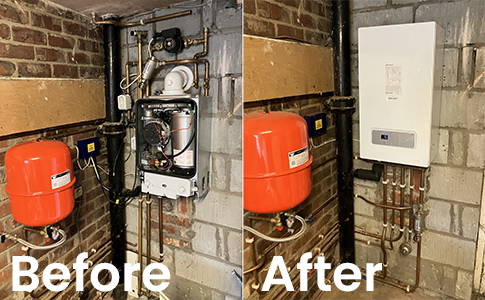
Repair or replace? A no-nonsense guide to winter boiler breakdowns
When your heating fails on a freezing morning, you want straight answers fast. Can this boiler be fixed today, or are you better off putting the money toward a new one?
This guide walks you through the common faults, the parts that tend to cost the most, what counts as an emergency, and a simple decision tree you can follow in minutes. It is written for homes across Greater Manchester and Cheshire, where winter call-outs spike and peace of mind matters.
If you need urgent help, contact a Gas Safe registered engineer. Do not open the boiler casing yourself.
First steps in a no-heat situation
Stay safe and do a couple of quick checks before you call:
- Check the boiler pressure gauge. Cold system should sit around 1 to 1.5 bar. If it is very low, you may be able to top up using the filling loop, then reset.
- Verify power and controls. Is the fuse on, programmer set to on, and room thermostat calling for heat
- Look outside. A frozen condensate pipe can stop condensate flow and lock out the boiler. If safe to do so, thaw gently with warm (not boiling) water and re-insulate.
If you smell gas, suspect carbon monoxide, see scorch marks, or the boiler repeatedly trips the electrics, turn the appliance off and call a Gas Safe registered engineer immediately.
What counts as an emergency?
Book an urgent visit if you have:
- No heat and vulnerable occupants, very low temperatures, or infants or elderly people at home
- Suspected gas leak or carbon monoxide alarm sounding
- Water leaking from the boiler or system at a rate you cannot contain
- Complete loss of hot water in winter where health is at risk
In Greater Manchester and Cheshire, same-day call-outs are often possible in cold snaps, but availability can vary during peak weather. Ask about likely response windows when you ring.
Common boiler problems and likely causes
These faults crop up most in winter:
- Low pressure: Often due to a small leak or recent radiator bleeding. Topping up and finding the source usually resolves it.
- Ignition failure: Faulty electrode, blocked condensate, or gas supply issue. Units may lock out with an error code.
- Pump failure: No circulation, kettling noises, or hot pipes near the boiler but cold radiators.
- Diverter valve fault (combi): Hot water works but heating does not, or the reverse. Temperature swings at taps are common.
- Printed Circuit Board (PCB): Intermittent or total failure, random resets, or dead controls.
- Thermostat or sensor issues: Poor temperature control, short cycling, or inconsistent heating.
Other frequent culprits include scaled or blocked plate heat exchangers (especially in hard-water areas), pressure relief valve discharge, and sludge in the system restricting flow.
Typical repair costs, from quick fixes to big-ticket parts
Prices vary by model, parts availability, and fault complexity. As a broad guide:
- Minor repairs and resets: Low labour time, often the least expensive.
- Sensors, electrodes, small valves: Usually mid-range.
- Pumps and diverter valves: Often higher due to parts and labour.
- Plate heat exchangers: Can be costly, especially if scale or sludge caused damage.
- PCB replacement: Typically among the most expensive single-part repairs.
If a single repair approaches a significant share of the price of a modern boiler, it is time to weigh replacement.
Signs your boiler may be at end of life
Consider planning a replacement if you notice:
- Age: 12 to 15 years old or more, especially with rising faults
- Frequent breakdowns: Two or more significant issues in a year
- Rising energy bills: Older units are often less efficient and may short cycle
- Unavailable or discontinued parts: Long waits or high costs to source components
- Safety concerns: Yellow flames, sooting, or repeated lockouts
- Patchy heat: Radiators slow to warm and pressure drops that keep returning
The quick decision tree: repair or replace?
Work through these checkpoints:
Age and condition
- Under 10 years, well-serviced, first fault: lean to repair.
- Over 12 to 15 years with multiple faults: lean to replace.
Efficiency and running costs
- Old non-condensing or poor controls: replacement can improve comfort and lower bills.
- Efficient condensing boiler with a single failed part: repair likely best.
Fault frequency and severity
- Repeated pump, diverter, or PCB failures: replacement becomes more cost-effective.
- One-off sensor or simple valve: repair.
Warranty and service history
- In-warranty or under a care plan: repair under terms.
- Lapsed servicing and worn internals: weigh replacement.
Parts availability
- If parts are scarce or premium priced, consider a new boiler.
Total spend outlook
- If the next 12 to 24 months looks like several mid-to-high repairs, a planned replacement can save you money and stress.
Who to call and what to expect locally
Choose a Gas Safe registered engineer for any gas boiler work. A local, reputable team will diagnose quickly, explain options, and provide a written estimate so you know what is included. In cold snaps across Greater Manchester and Cheshire, aim to call early in the day. Ask about temporary heat tips if parts must be ordered.
If you are comparing long-term options, you can explore new boiler installation as well as broader heating system improvements. For example, you can learn more about efficient replacements on our boiler installation page, or consider targeted heating system upgrades like better controls and emitters to stabilise running costs.
- Helpful next steps: see modern options for boiler installation in Bramhall at the Warmflame Gas boiler installation page: https://www.warmflamegas.co.uk/boiler-installation
- If you need a fast fix first, learn about local boiler repair support here: https://www.warmflamegas.co.uk/boiler-repair
- Planning ahead for fewer surprises? Explore heating system upgrades that can improve comfort and efficiency: https://www.warmflamegas.co.uk/heating
Is it cheaper to repair or replace?
Short term, a repair is usually cheaper. Over the next few winters, the maths can flip if your boiler is old, unreliable, or inefficient. Factor in expected future repairs, energy use, and potential downtime. A well-specified replacement can stabilise costs and reduce hassle, but do not replace a relatively young, efficient boiler for a single minor fault.
Care plans and prevention
An annual service helps keep your boiler safe, efficient, and within warranty terms. A care plan can spread costs and reduce the risk of winter surprises. Regular servicing also helps spot issues like sludge, scale, and low pressure before they become breakdowns.
FAQ: quick answers
- How much does a boiler repair usually cost?
Costs vary by part and labour. Small components and resets are usually modest, while pumps, diverter valves, plate heat exchangers, and especially PCBs sit at the higher end. Ask for a clear estimate after diagnosis.
- What are common boiler problems?
Low pressure, ignition failures, pump faults, faulty diverter valves, PCB issues, blocked condensate pipes, and scaled plate heat exchangers.
- What are signs that a boiler needs replacing?
Age over 12 to 15 years, frequent faults, poor efficiency, unavailable parts, safety concerns, and uneven heating.
- Who should I call to fix my boiler?
A Gas Safe registered heating engineer. In Greater Manchester and Cheshire, local availability increases your chances of a same-day visit during cold weather.
- Is it cheaper to repair or replace a boiler?
Usually repair in the short term. Replacement becomes better value if the boiler is older, inefficient, or facing repeated high-cost faults.
Summary and next step
If your boiler stops this winter, start with safe checks, then call a Gas Safe engineer for diagnosis and a written estimate. Repair makes sense for younger, efficient units with simple faults. Replacement is prudent when age, efficiency, part availability, and repeated issues point to rising total cost of ownership. If you are ready to compare options, explore boiler installation for long-term reliability, or request help today through our boiler repair service.